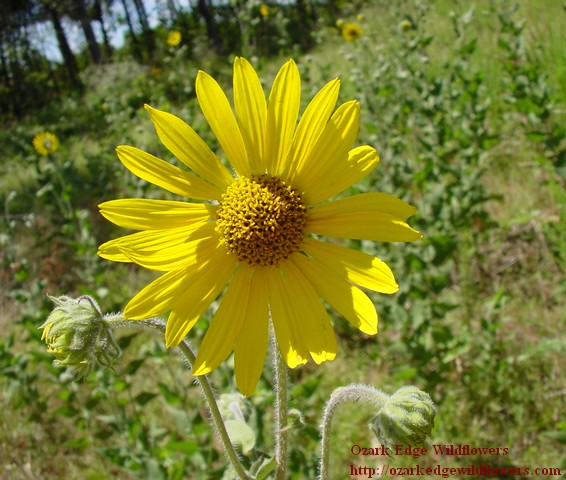
Helianthus mollis is probably my favorite sunflower on Ozarkedge. I watch the plants emerge each spring and eagerly await their summer blooms. Clumped together in a large colony, their simultaneous blooms look like a huge summer bouquet. Sunflowers are often described with adjectives such as joyful and happy. They seem to represent the best of our hopes and dreams for summer. These sunflowers, in particular, represent that to me.
Latin Name/Common Name- Sunflowers (Helianthus) are grouped under the Asteraceae family. There are many native and cultivated sunflowers within Helianthus genus. The name Helianthus is derived from the Latin “helios” (sun) and “anthos” (flower). The Latin meaning of “mollis” is soft. So, Helianthus mollis has a common name of Soft sunflower. It is also known as Ashy or Downy sunflower because of its distinct sage green foliage and downy stems.
Bloom Color- Lemon yellow petals (rays) on the flowers provide a beautiful contrast with the gray-green leaves of Helianthus mollis. The central disk, composed of the florets (disk flowers) is initially green to brown. As the flower matures, the disk gradually turns yellow beginning with the outermost florets.
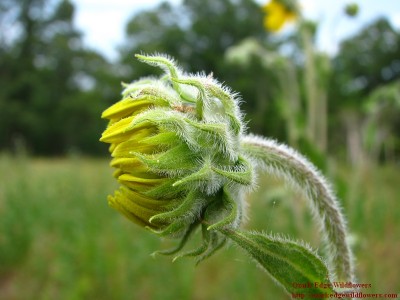
Flower bud
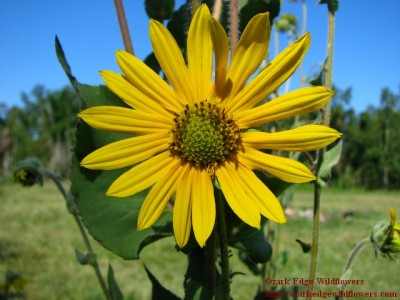
The 15-30 ray flowers are heavily creased
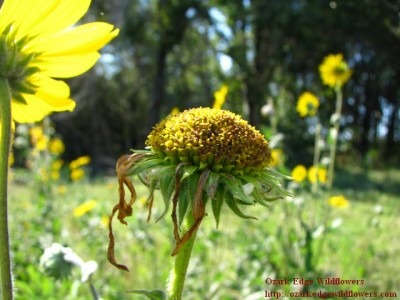
Still beautiful after blooming
Description- This pretty sunflower is about 4 to 5 feet tall at maturity. It is easy to distinguish Helianthus mollis from its’ relatives by noting the gray-green foliage covered with a profusion of fine hairs. The early spring growth is particularly beautiful as the young leaves look like they’ve been frosted with soft white hairs.
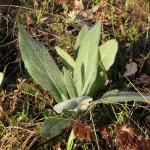
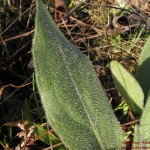
The new spring leaves are look frosted with soft, white hairs
At maturity, the leaves become stiffer and are not as pleasant to the touch. The hirsute stem remains unbranched until dividing into a few flowering stalks near the top of the plant.
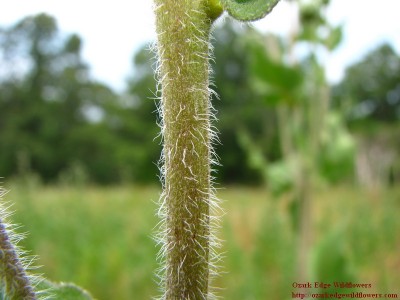
Pubescent stem
The broad, lanceolate leaves are opposite and measure approximately 4″ in length and 2.5 ” in width. They are sessile (without stalks) and may clasp the stem.
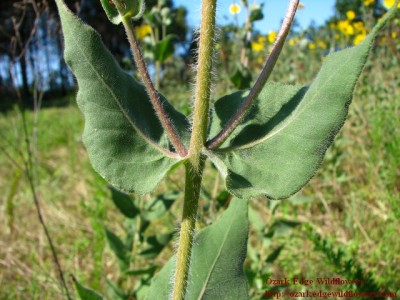
Stiff, opposite leaves clasping the stem
Dense hairs cover both sides of the leaves, hence the common name, Downy sunflower. The plant leaves develop rusty spots post maturity and quickly turn black if bruised or dried.
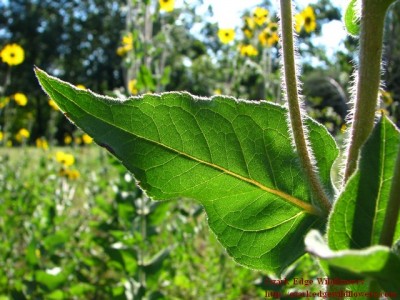
Leaves are covered with fine hairs on both sides
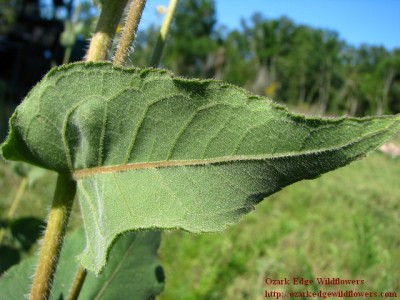
The undersides of the leaves have a unique gray-green or sage green coloration
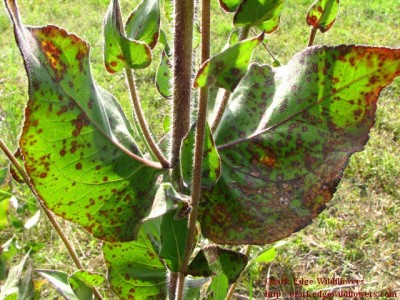
Post maturity, the leaves may develop rusty spots
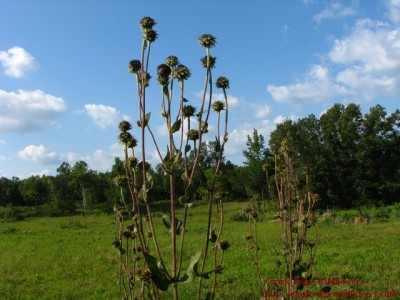
Seed heads in late August
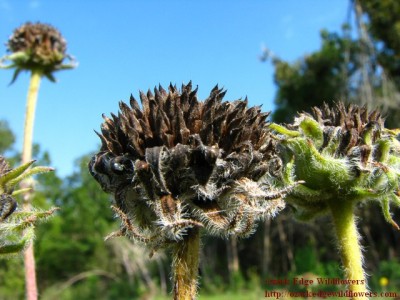
Close-up of seed head
The plant arises from rhizomes, which slowly spread to form colonies. The rhizomes release an allelopathic substance that suppresses the growth of competing plants.
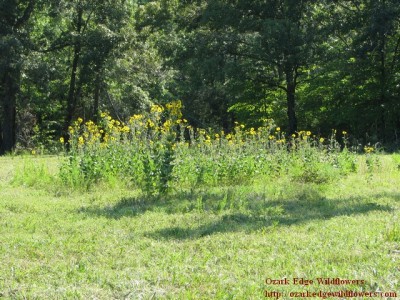
Colony of Helianthus mollis in sun-drenched field
Bloom Time- On Ozarkedge the peak flowering of Helianthus mollis is from July to early September. Occasional blooms may persist into October. Although Helianthus mollis thrives in dry sites, it may not bloom during years of severe drought.
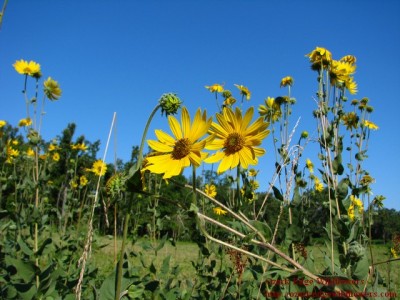
Helianthus mollis in full glory at the beginning of August
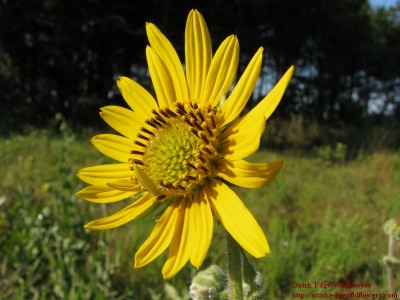
First bloom in early July
Habitat- Colonies of Ashy sunflower are found in prairies, thickets and fields. Here I’ve seen Helianthhus mollis growing on a dry site in a sunny, rocky field as well as in a thicket closer to the woodland edge. During two summers with sustained drought, the patch growing in the sunny site only produced a few small flowers. The shaded patch fared better, yet still did not put on the usual show. I hope this weather pattern will give us a break next year so the bees and I can enjoy these happy flowers.
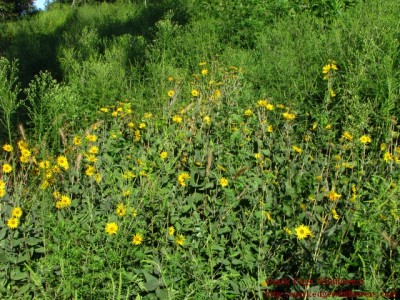
Colony growing in a thicket
What’s Growing Nearby? Wild petunia (Ruellia humilis) and Slender bush clover (Lespedeza virginica) are two companions that don’t seem to be affected by the alleopathic substance exuded by Helianthus mollis.
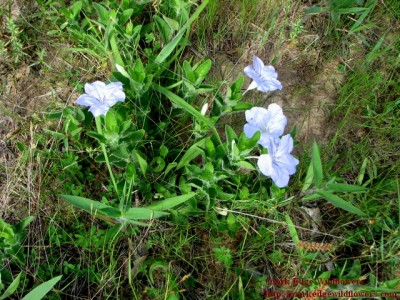
Wild petunia (Ruellia humilis) intermingles with Helinathus mollis
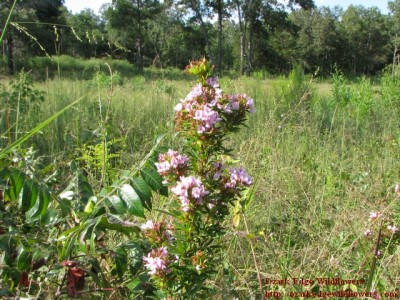
Slender bush clover (Lespedeza virginica) is another companion plant
Endangered List- Ashy sunflower is shown on the USDA Plant site as threatened in Ohio and Michigan. It is legally protected in Michigan, where it also appears on the state threatened list.
Natureserve shows Helianthus mollis to be Critically Imperiled in Nebraska, Imperiled in Michigan and Ohio and Apparently Secure in Georgia. The only state showing it as Secure is Kentucky. All other states within its native range are, unfortunately, Unranked.
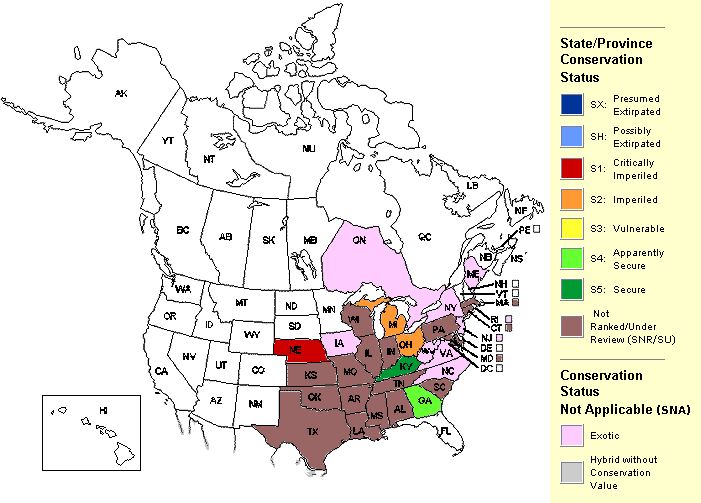
*NatureServe. 2018. NatureServe Explorer: An online encyclopedia of life [web application]. Version 7.1. NatureServe, Arlington, Virginia. Available http://explorer.natureserve.org. (Accessed: March 9, 2019 ).
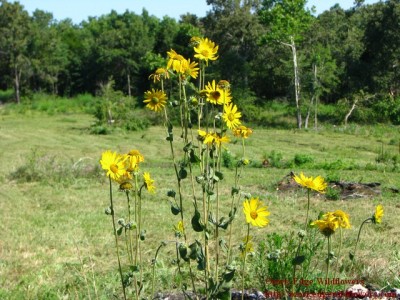
Helianthus mollis in full bloom
Interesting Tidbits- Bees love Helianthus mollis. The foliage provides important food for the caterpillars of hlosyne nycteis (Silvery Checkerspot) and Chlosyne gorgone (Gorgone Checkerspot). Goldfinches and other songbirds search out the seeds.
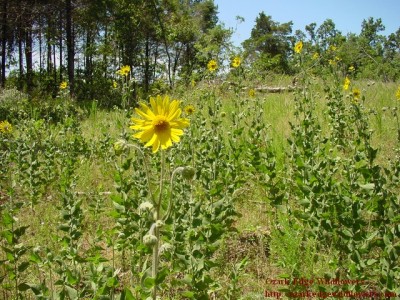
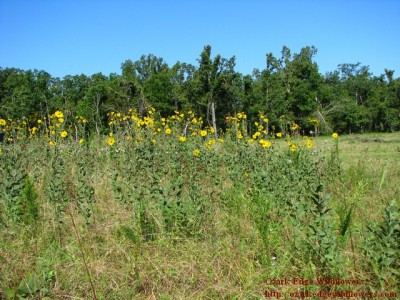
Many plants bloom at once forming a joyful display