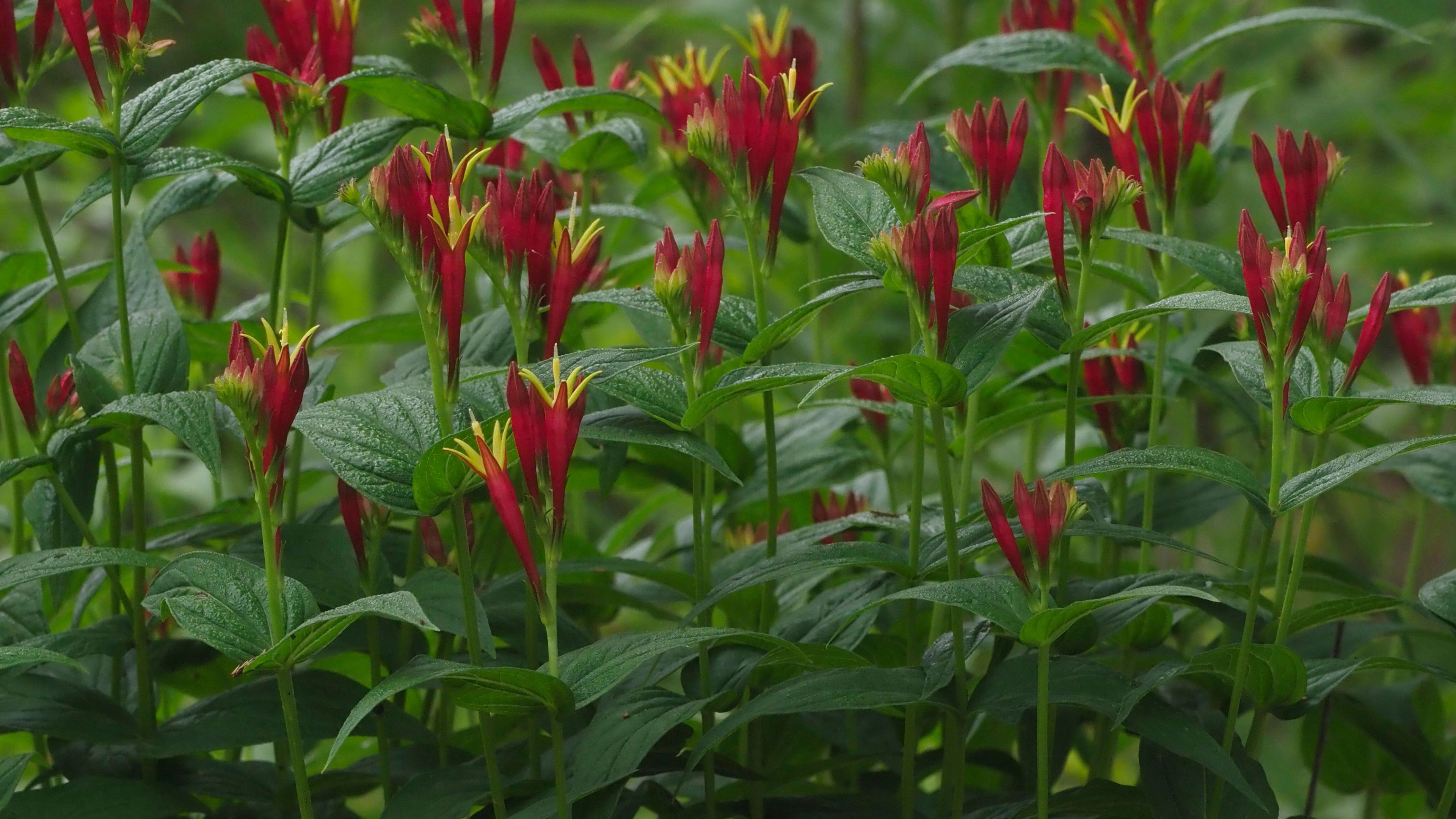
PLANT NAME
Spigelia marilandica is a perennial in the Loganiaceae family. This family consists primarily of tropical plants. The plant genus Spigelia was named in honor of Adriaan van den Spiegel (1578- 1625), a Belgian physician and anatomist who also practiced botany. Dr. van den Spiegel also described an uncommon abdominal hernia which bears his name- Spigelian hernia.
The name 'Marilandica' means 'of Maryland', although Spigelia marilandica is not found in Maryland.
Common names include Woodland pinkroot, Pinkroot, Indian pink and Worm grass.
BLOOM
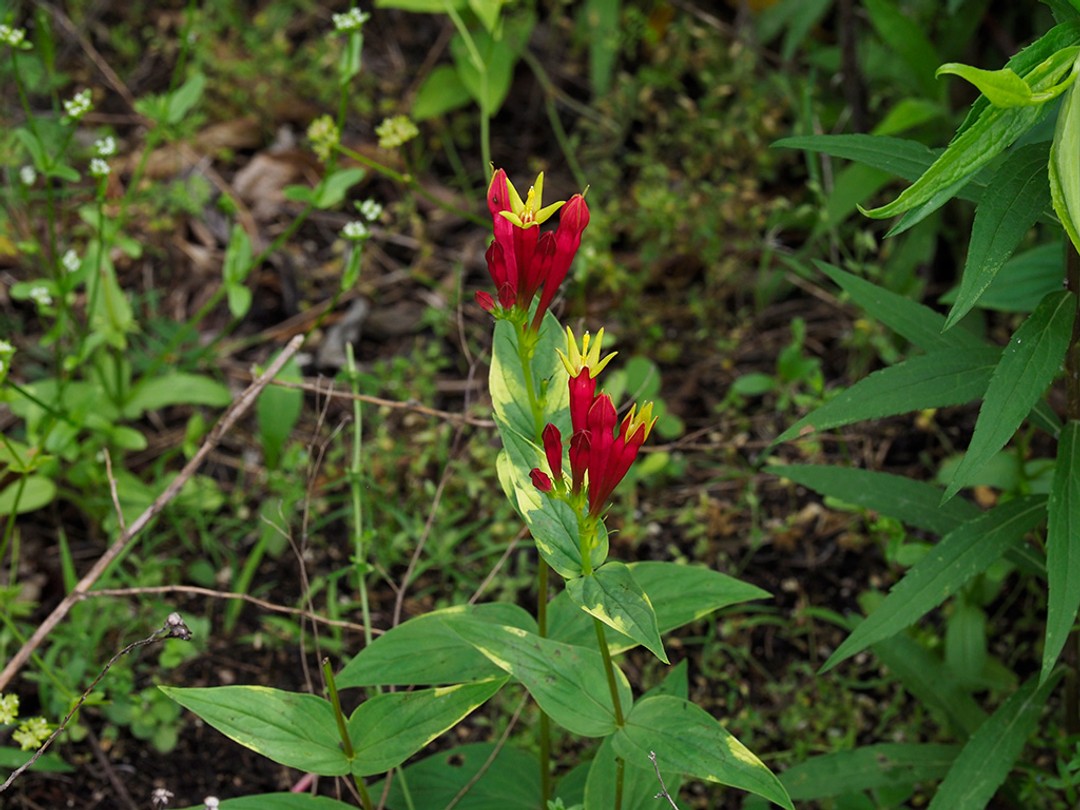
Blooming occurs at the cusp of spring and summer in May through early June. The flower of Spigelia marilandica is one of nature’s most striking color combinations. The scarlet red corolla flares at its top to display a central star of vivid deep yellow.
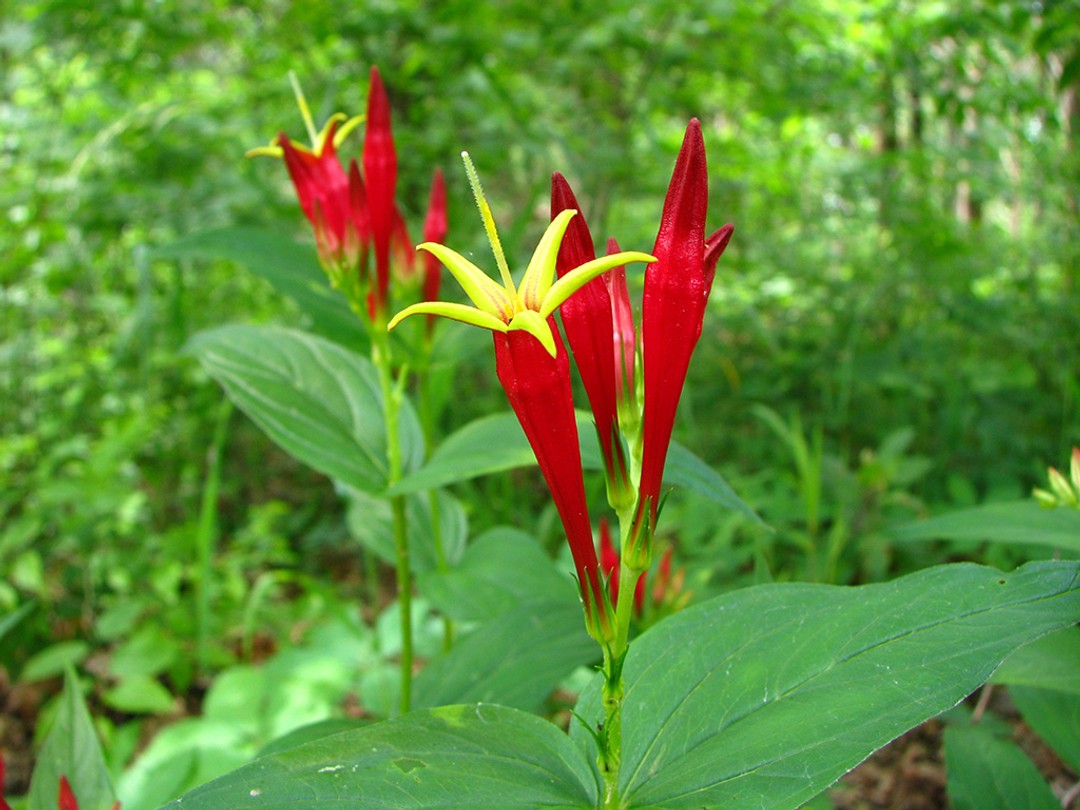
Vivid red and yellow flower 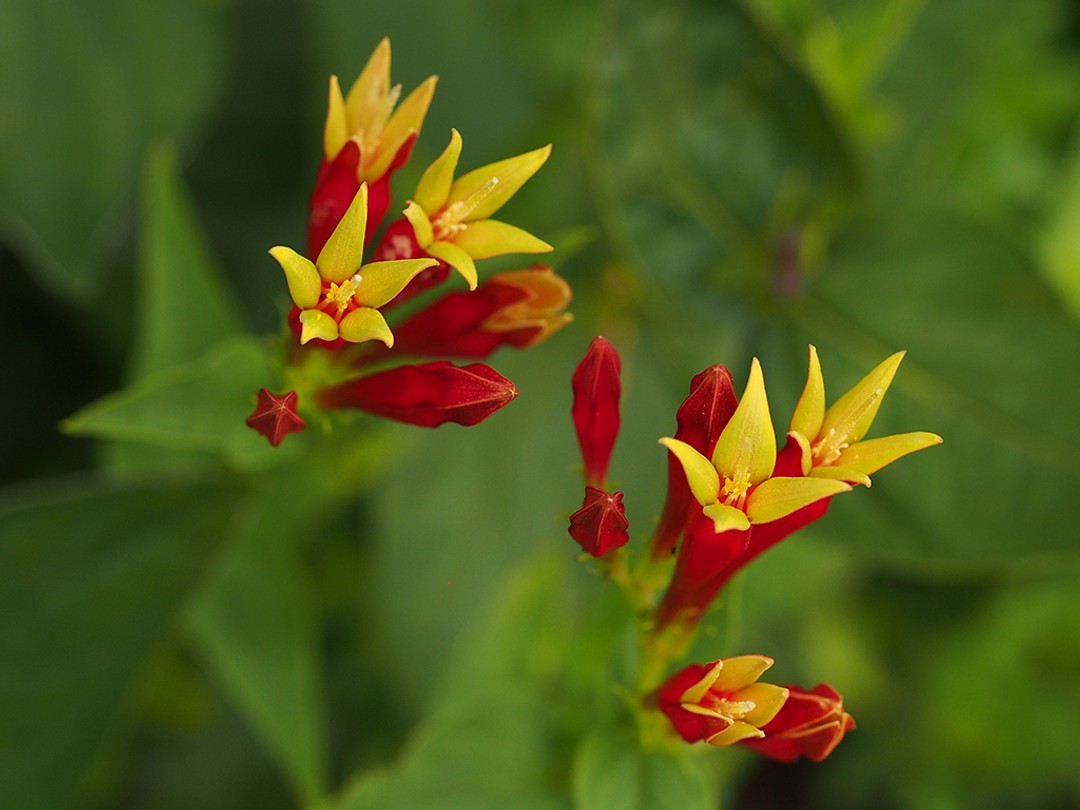
View of flowers from above
The buds appear at the top of the plant in a one-sided cyme. Flowering proceeds from the base of the cyme to the tip, consisting of 3 to 12 flowers. Each flower lasts 2 to 3 days.
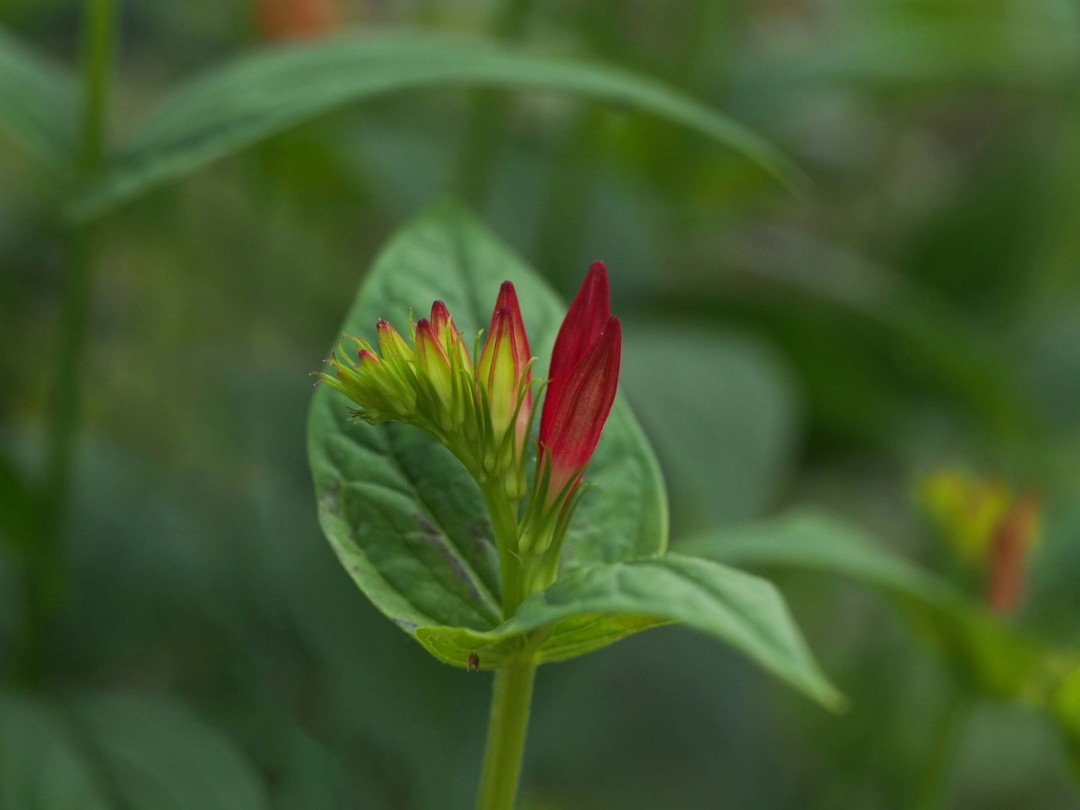
Cyme with buds 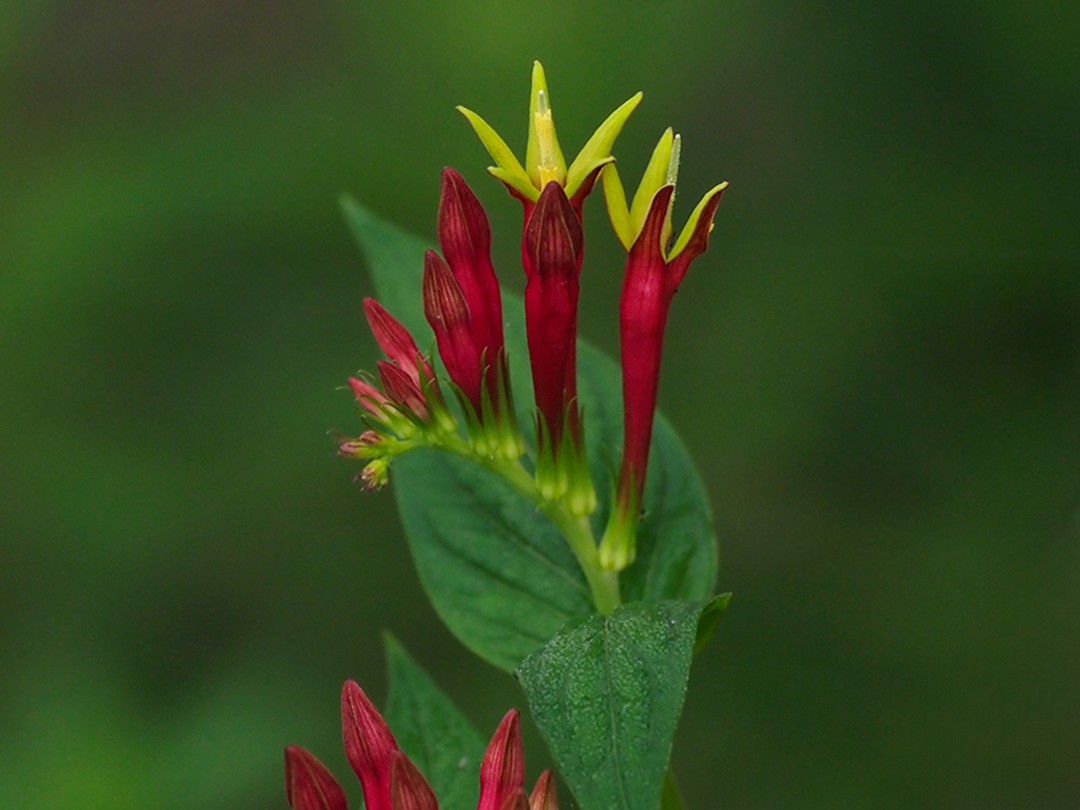
Blooming from base to tip
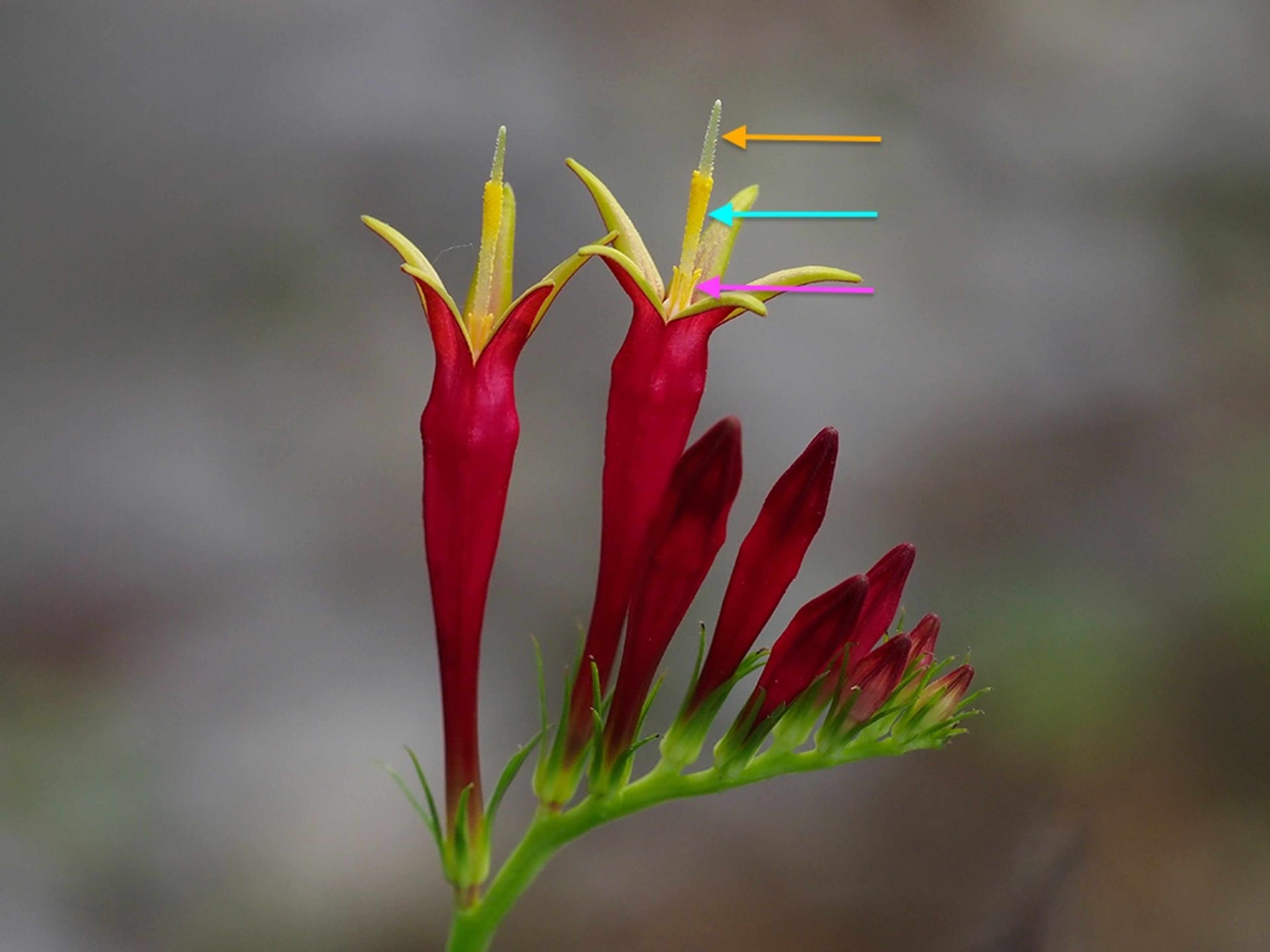
The style and stigma grow up through the anthers, basically assuring self-pollination. The style protrudes past the corolla. The fringed stigma is seen at the tip of the style. In the photo below, color coded arrows indicate the reproductive parts- stigma (yellow), style (blue) and anthers (pink).
Although blooming typically ends by mid June, plants may reflower later in the season. This usually occurs when the initial flowering has been disturbed by drought or browsing by deer. Even though Woodland Pinkroot is generally considered a deer resistant plant, it is occasionally browsed.
DESCRIPTION
Spigelia marilandica grows in clumps reaching 1-2 feet. Each clump produces numerous four-sided stalks that arise from fibrous roots.
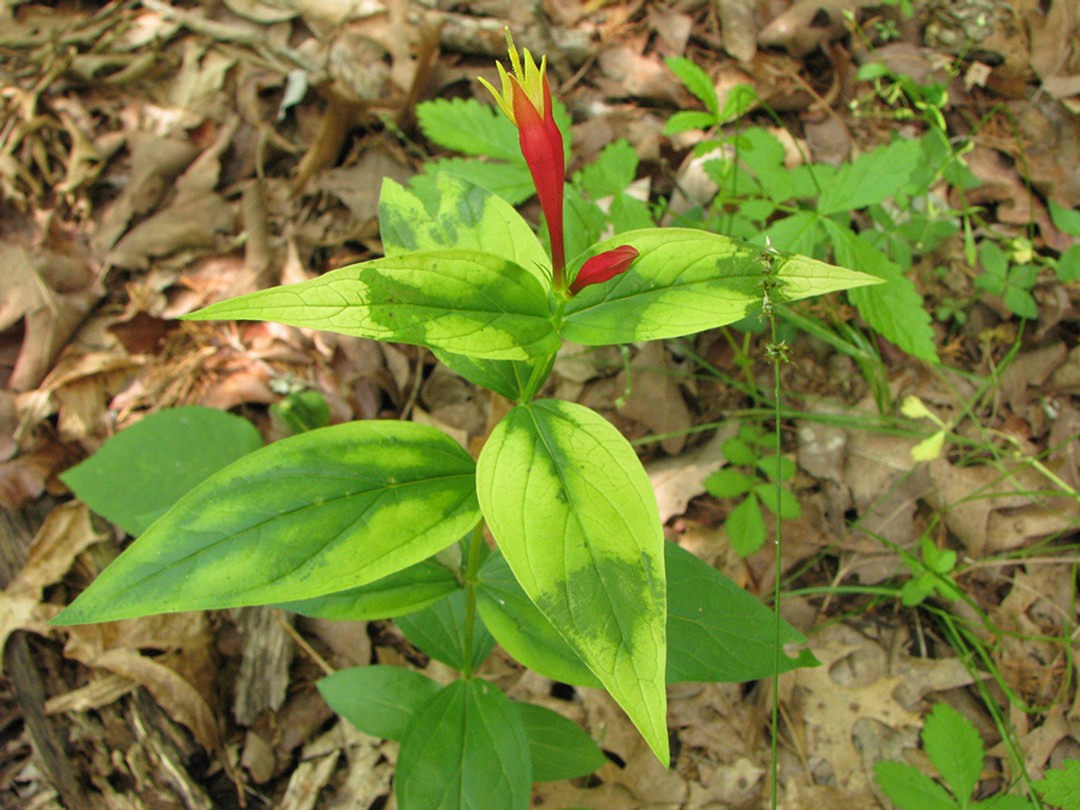
The beautiful leaves are opposite, sessile and lanceolate or ovate with a rounded base and smooth margins. They often have a slight pubescence underneath. At maturity, they reach a dark, true green color.
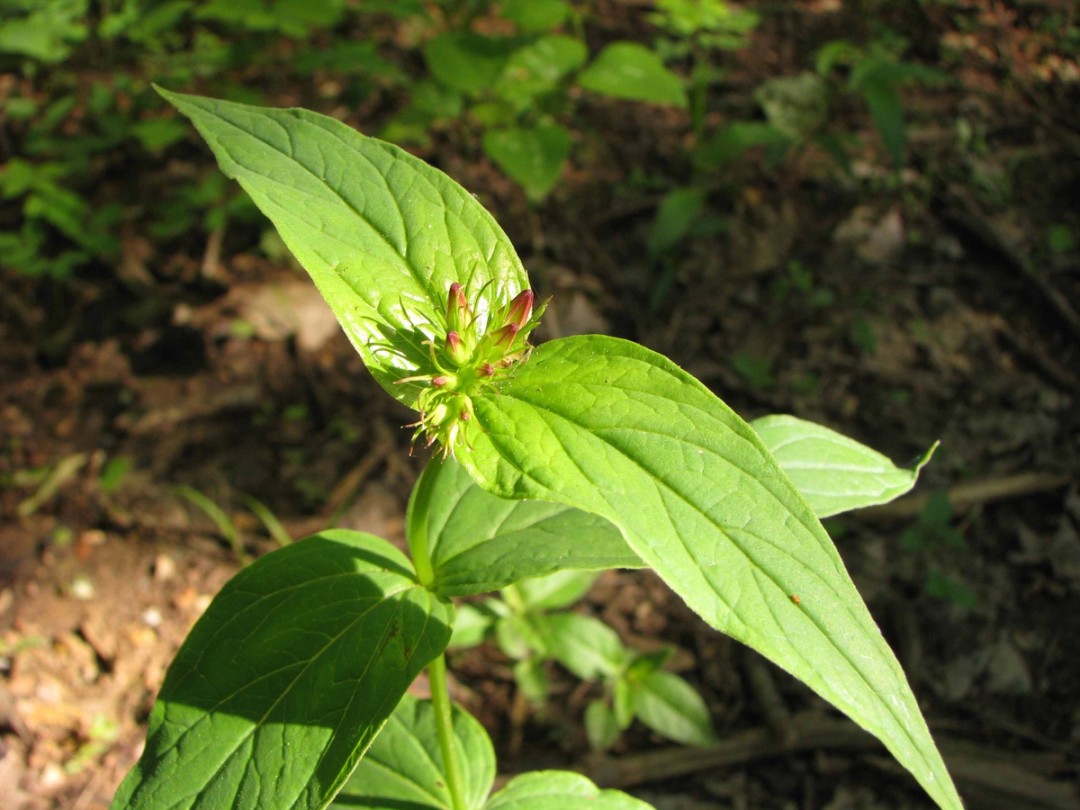
Leaves and buds 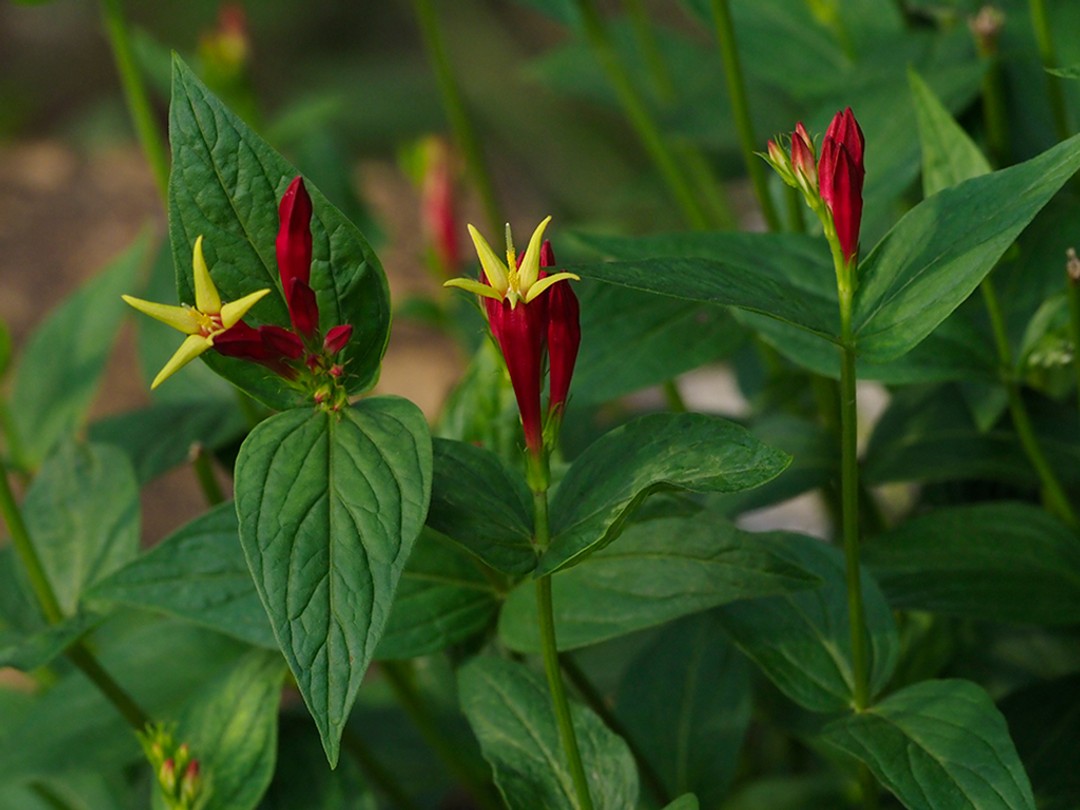
Opposite leaves
I’ve observed some plants on Ozarkedge develop variegated leaves with yellow streaks alongside green. Some just have yellow tips, but in others the dark green is nearly replaced with yellow. The plants are otherwise healthy and proceed to bloom. I’m not sure what causes the yellow patterns in the leaves, but perhaps it is associated with soil ph or possibly a virus. I haven’t uncovered any information regarding this in my research.
The seed pod consists of 2 round capsules joined in the center. Seed pods gradually change from green to black as they ripen.
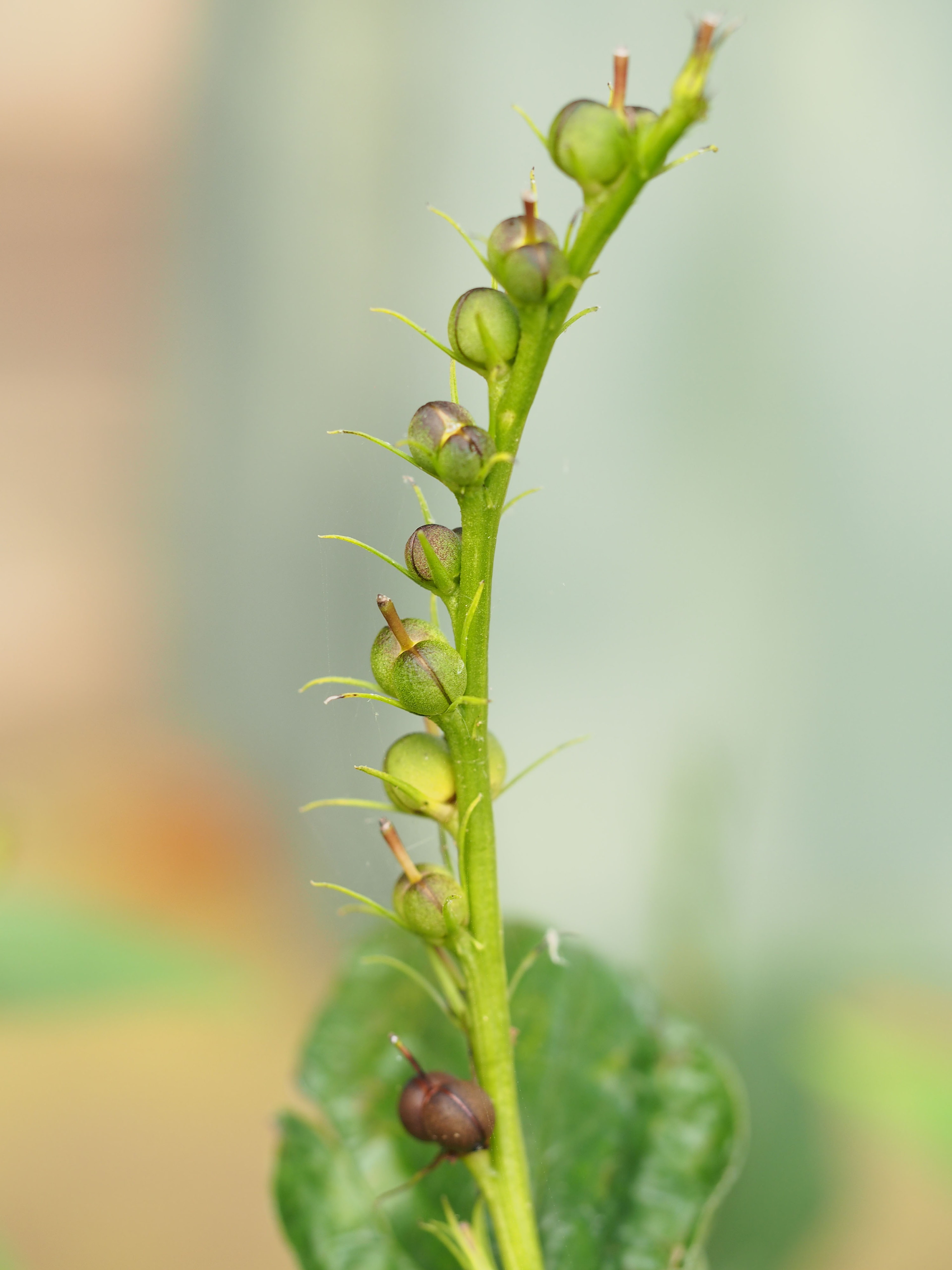
In July, the capsules blacken on top and dehisce (open to release seeds). The bottom of ripe seed pods may remain green. Once ripe, the seed pods burst, releasing seeds explosively, widely dispersing them from the mother plant. In order to save seed for propagation, seed pods must be checked regularly or bagged. Best results occur if the seed is sown straight away. New plants typically flower in their second year.
POLLINATORS
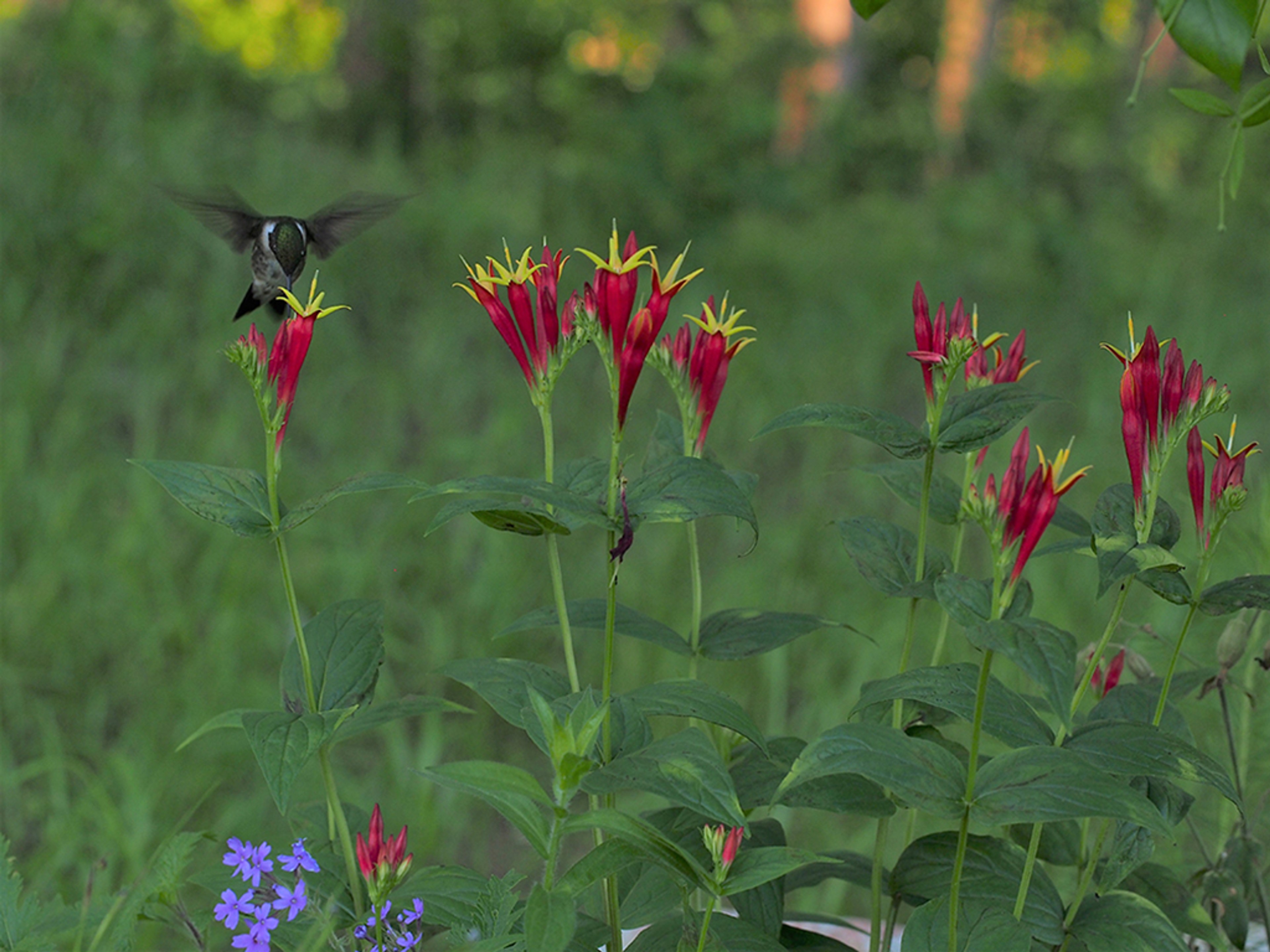
While Spigelia marilandica is primarily self pollinated, it is occasionally visited by Ruby throated hummingbirds and Syrphid flies (Shots, G. S. (2021). Floral Biology of Alabama’s Spigelia species (Family Loganiaceae.).
Ruby throated hummingbirds are fascinating to observe as they consume the plants nectar. They fly from plant to plant so quickly that catching a photo can be quite a challenge!
PLANTS GROWING NEARBY
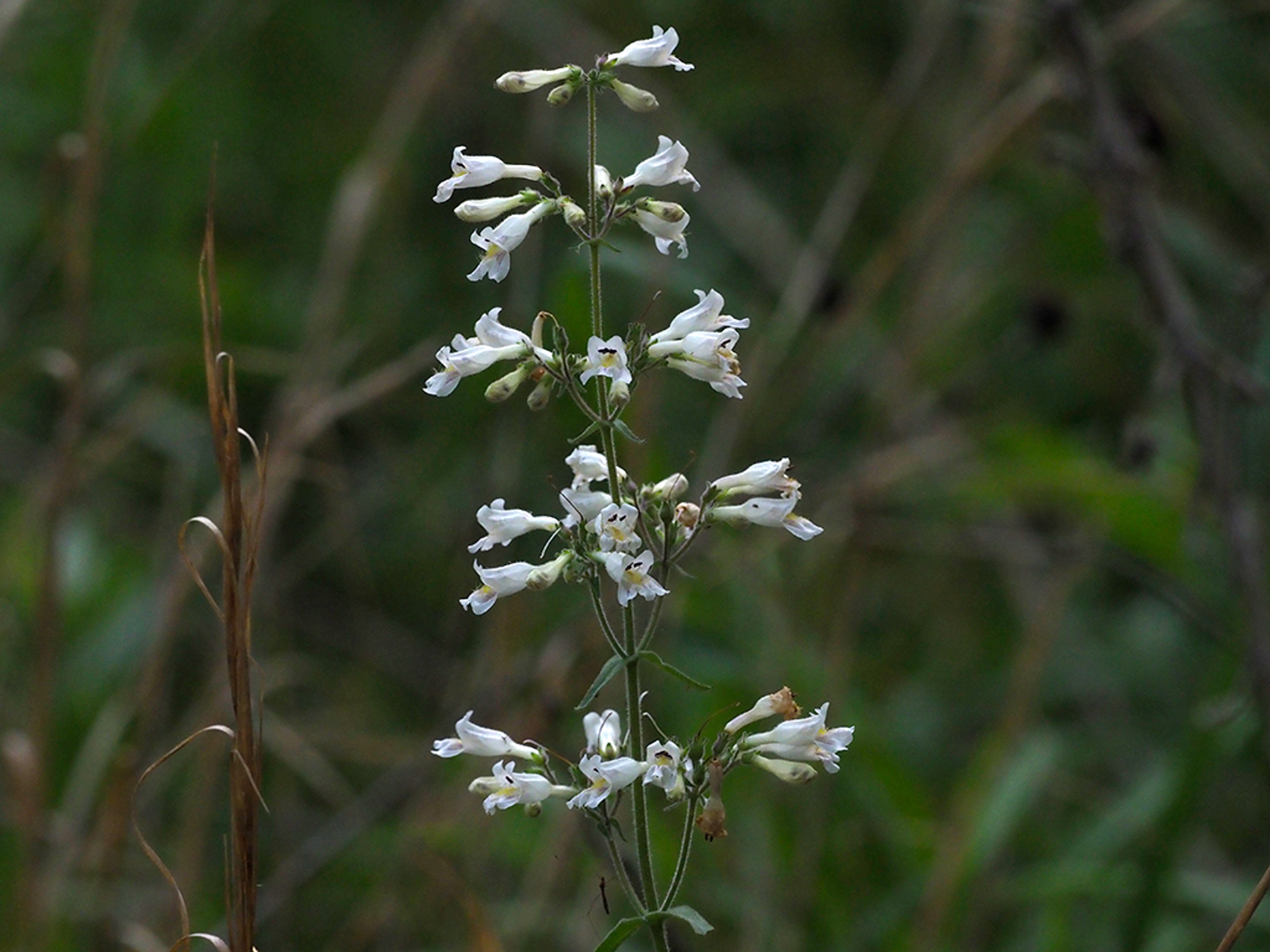
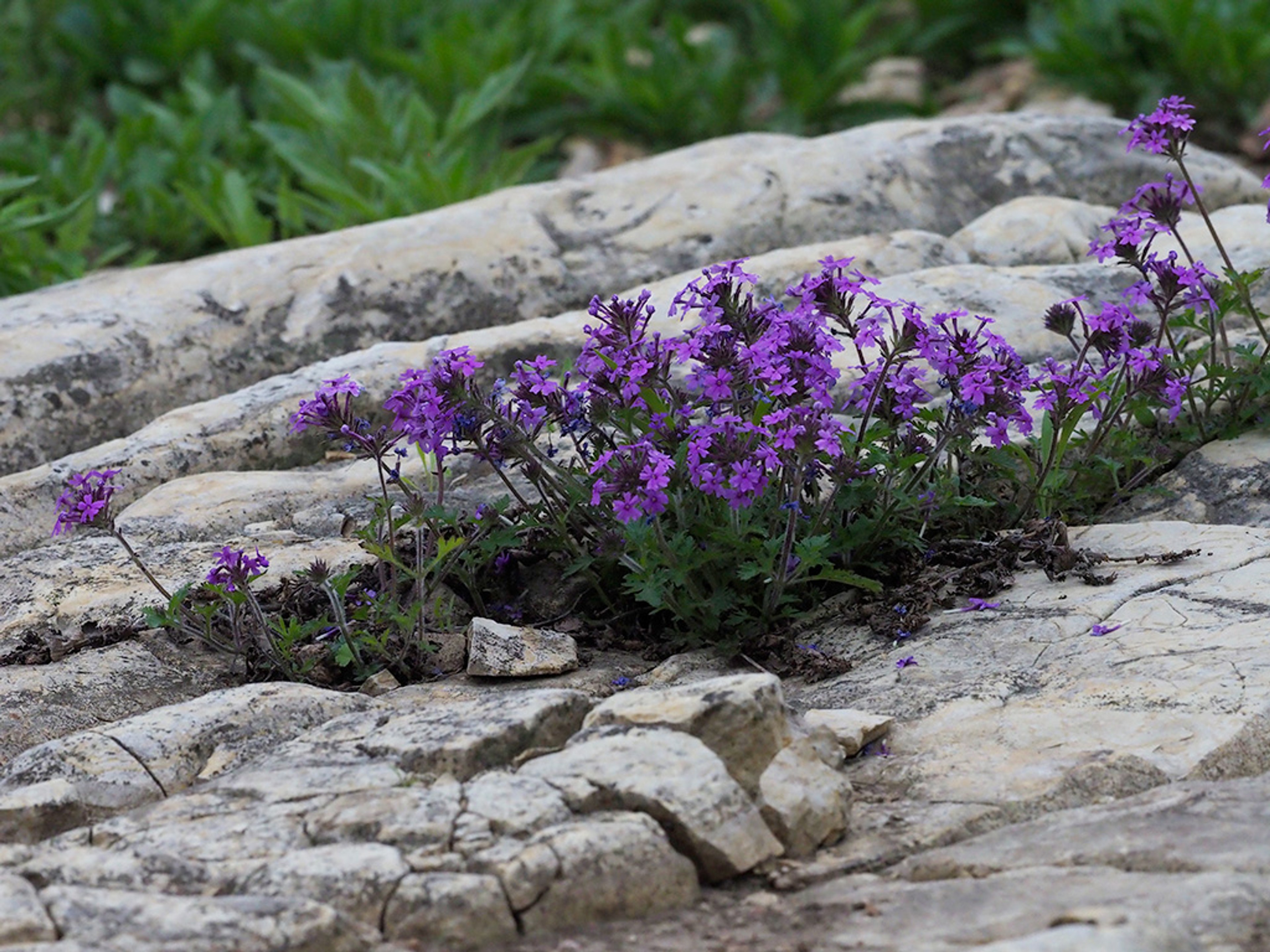
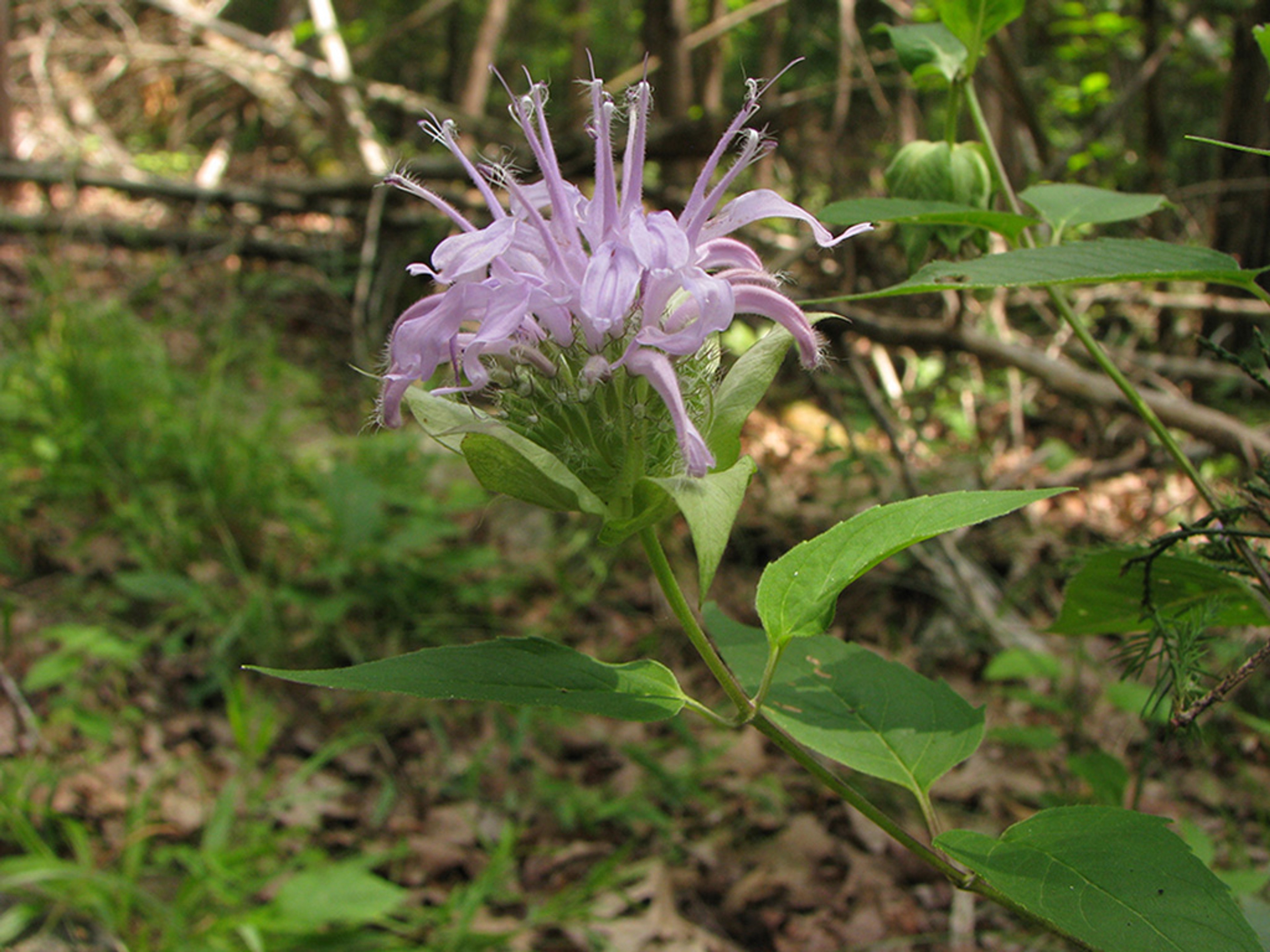
Spigelia marilandica has many friends at the woodland border, both grasses and flowers. Chasmanthium latifolium, river oats is one of the more distinctive nearby grasses. Flower companions you may find include Monarda fistulosa (Wild bergamot), Coreopsis grandiflora (Coreopsis), Anenome virginiana (Thimbleweed), Ruellia pedunculata (Stalked Wild Petunia), Erigeron strigosus (Daisy fleabane), Anemone virginiana (Thimble weed), Penstemon pallidus (Pale beardtongue( and Silene stellata (Starry campion).
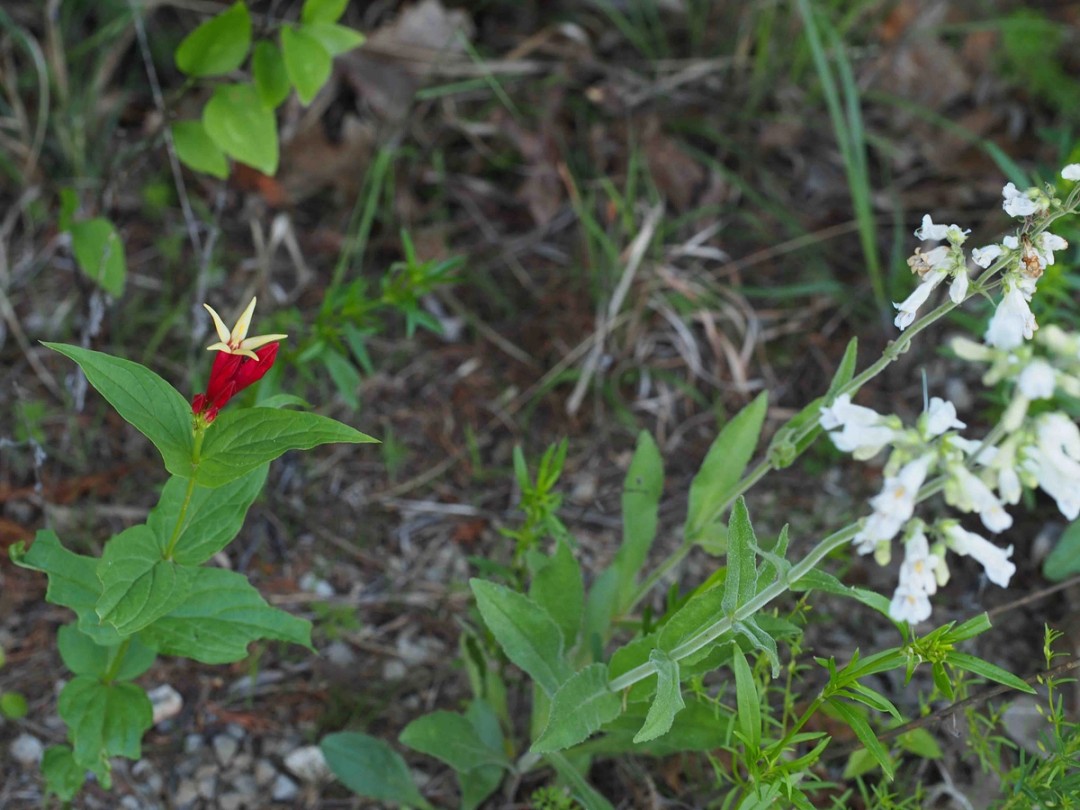
Pale beardtongue 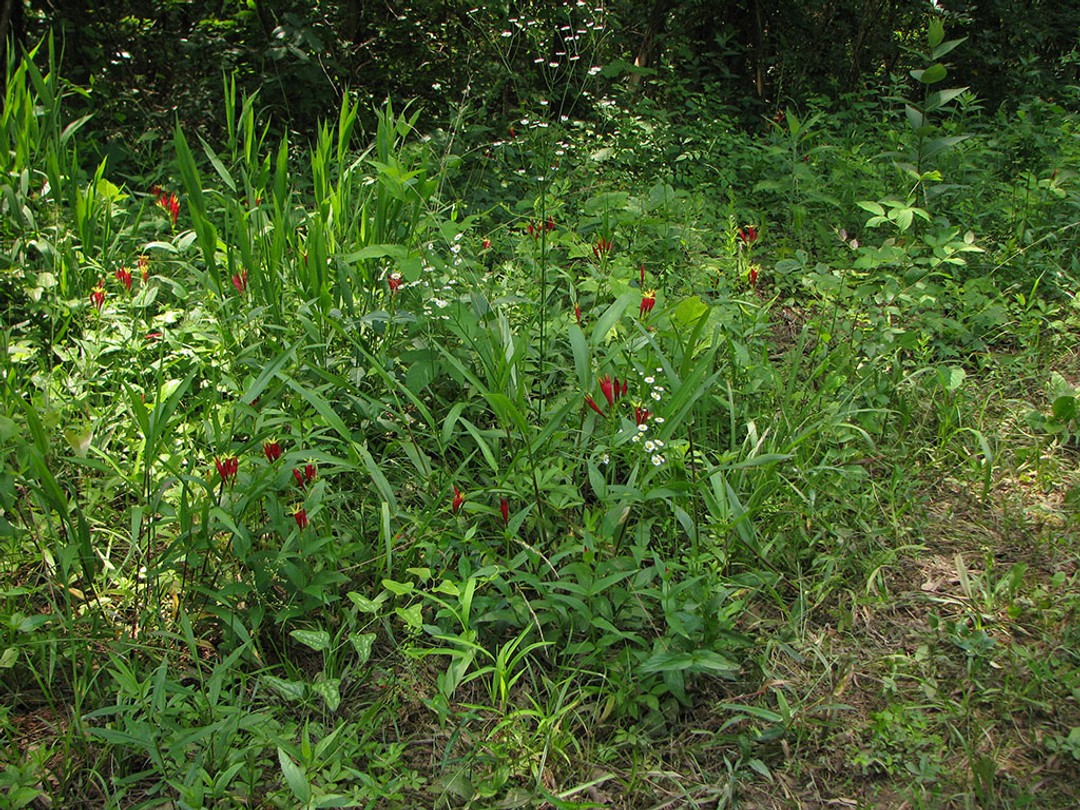
River oats
HABITAT
Spigelia marilandica prefers a partially shady habitat and is commonly found in rich, moist woods, woodland edges and along stream banks. In a garden setting, it will tolerate more sun.
Woodland edge habitat 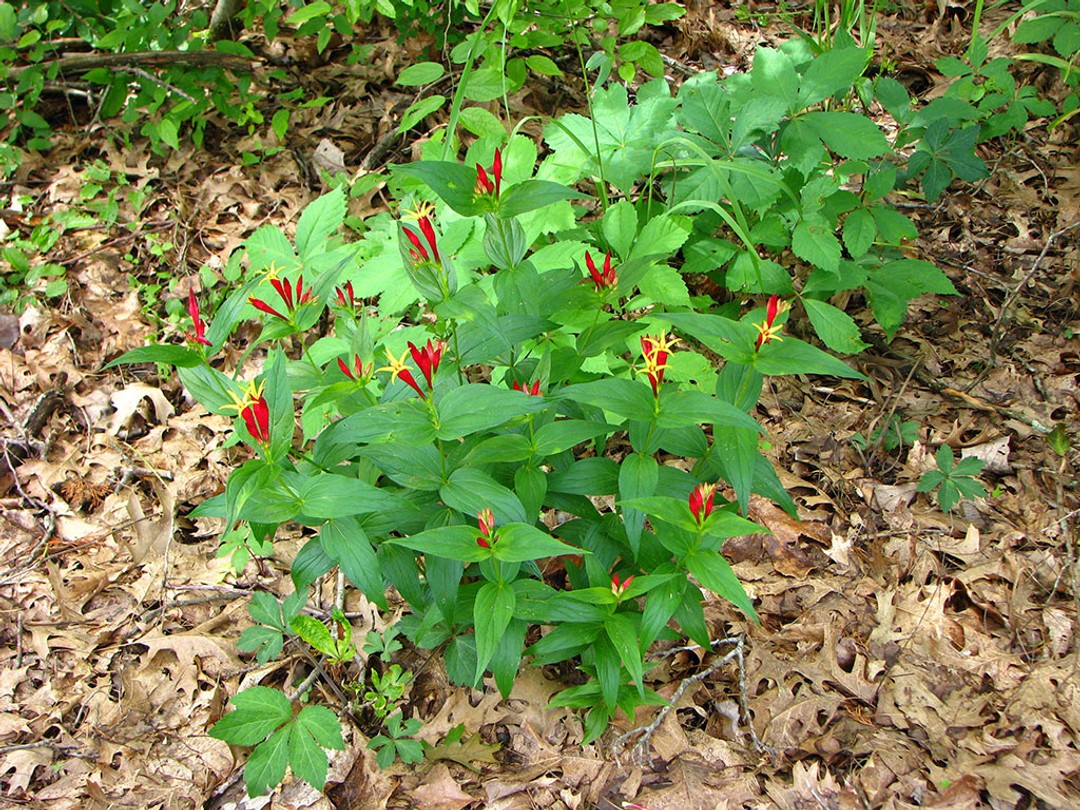
Woodland habitat
CONSERVATION STATUS
Spigelia marilandica is native from the southeastern states, west to Texas and Oklahoma and north to Illinois and Indiana. Natureserve shows it as Critically Imperiled in Indiana and North Carolina. It is Vulnerable in Florida. It's Apparently Secure in South Carolina and Secure in Kentucky. All other states within its range show No Status on Natureserve.
In Arkansas it has a Conservation value of 7 in the group of 4-7 meaning "Typically matrix taxa in intact, stable habitats, with some limited ability to respond to destabilizing forces and repopulate areas from which they have been extirpated."
INTERESTING TIDBITS
Woodland Pinkroot plants contain a poisonous alkaloid called Spigeline. This was once used in a root tea to treat those ill with worms or other parasites. However, all parts of the plant are now considered poisonous.